
Introduction
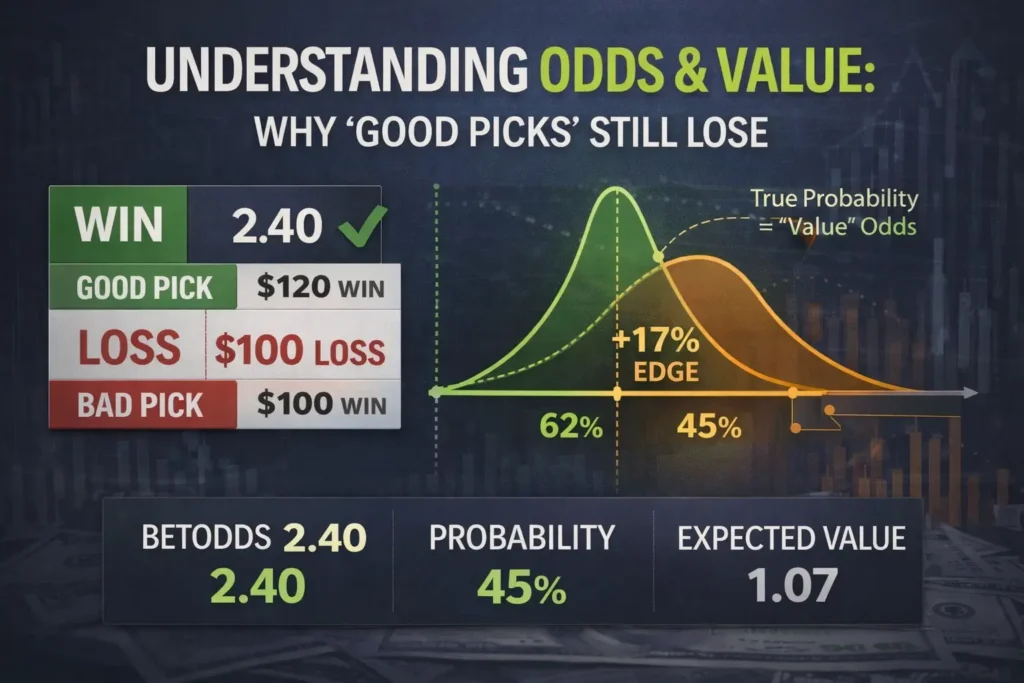
A common mistake is judging a pick by the result:
-
Win = “good pick”
-
Loss = “bad pick”
That’s not how real edge works. A good bet can lose, and a bad bet can win. What matters is whether you consistently take prices that are better than the true probability—this is called value.
Odds are just probability in disguise
Every odd implies a probability.
For decimal odds:
Implied Probability = 1 / Odds
Examples:
-
Odds 2.00 → 1/2.00 = 50%
-
Odds 1.80 → 1/1.80 = 55.56%
-
Odds 3.00 → 1/3.00 = 33.33%
If you believe the real probability is higher than the implied probability, you may have value.
What “value” means (simple definition)
A bet has value when:
Your estimated win probability > bookmaker implied probability
Example:
-
Book offers 2.10 (implied 47.62%)
-
Your model/process estimates 52%
-
That’s value.
You won’t win every time—but over many bets, value is what creates long-term profit.
Why you can do everything right and still lose
Because sports outcomes are noisy:
-
Red cards
-
Injuries
-
Bad shooting variance
-
Overtime
-
Garbage-time points (totals)
If your edge is real, the goal is not to “avoid losses.” The goal is to make correct decisions repeatedly.
Think in samples:
-
20 bets: noise
-
200 bets: trends start to appear
-
1,000 bets: edge becomes clearer (if it exists)
Closing line value (CLV): the best KPI you’re not tracking
If you regularly beat the closing line, it often indicates you’re on the right side of the market.
Example:
-
You take Over 2.5 at 1.95
-
It closes at 1.80
-
Market moved toward your bet → good sign
CLV doesn’t guarantee profit—but it’s a strong process metric.
How BonPredict is built around value
A prediction isn’t “we feel it.” It’s:
-
data signals
-
matchup context
-
price selection (odds)
-
risk-managed staking
We don’t promise 100% wins. We aim for consistent value.